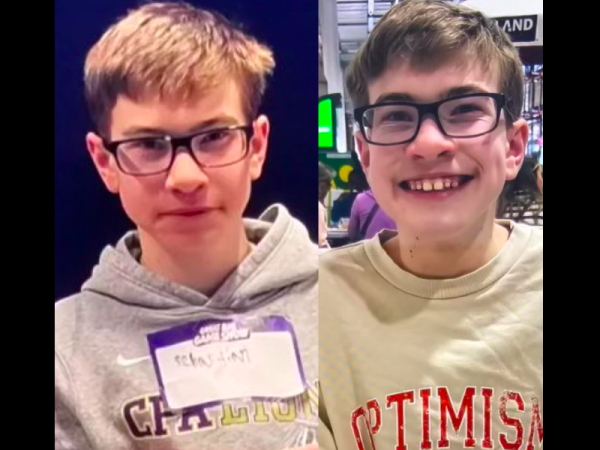
More than two years after Sebastian Rogers vanished from his Hendersonville home, his father says the agencies charged with protecting his son — and later finding him — failed at both.

www.wsmv.com
‘They failed my son’: Sebastian Rogers’ dad sues sheriff, state agency over Tennessee teen’s disappearance
For 870 days, Seth Rogers has lived with a single unanswered question.
What happened to his son?
“I need my son home,” said Rogers. “There’s nothing else.”
Now, nearly two-and-a-half years after 15-year-old Sebastian Rogers disappeared without a trace from the Hendersonville home he shared with his mother and stepfather, his father is asking a second question he says has become just as important.
On Wednesday, Rogers filed two sweeping federal lawsuits that accuse the agencies responsible for protecting Sebastian before he disappeared, and investigating his disappearance afterward, of failing him at nearly every stage.
One lawsuit targets the Sumner County Sheriff’s Office (SCSO), alleging investigators mishandled the missing-person investigation from its earliest hours by failing to secure the home as a potential crime scene, pursue critical investigative leads and devote adequate resources to the case.
That suit also names Sumner County Sheriff Eric Craddock, and detective Brandon Carter, the alleged “sole detective assigned to Sebastian’s missing person investigation.”
The second lawsuit is against the Tennessee Department of Children’s Services (DCS), alleging the agency failed to protect Sebastian despite two closed investigations involving the teenager before he vanished.
Several DCS officials are also named in that complaint, including DCS Commissioner Margie Quinn, a case worker, an agency supervisor and a DCS team leader.
Together, the lawsuits paint the broadest and most detailed public picture yet of why Rogers believes the mystery surrounding his son’s disappearance is not simply about what happened on the night Sebastian vanished — but whether government agencies repeatedly missed opportunities both before and after that night.
“So, he was failed by both of them,” Rogers told WSMV4 Investigates during an exclusive interview.
“My son wasn’t protected. My son wasn’t found,” said Rogers. “It makes you want to sleep, but it’s a nightmare.”
According to the complaint filed on Wednesday, Rogers alleges the SCSO investigation was inadequate, negligent, and ultimately abandoned.
The 21-page civil rights suit claims investigators failed to secure the Proudfoot home, allowing family members and media inside, before it was processed as a crime scene.
It also alleges that investigators failed to verify Christopher Proudfoot’s alibi, and that they failed to investigate why surveillance cameras at the home were not working. According to the lawsuit, that “should have been a significant cause of suspicion and point of thorough investigation, because, upon information and belief, Katie Proudfoot installs and operates security cameras for a living.”
The complaint also alleges investigators did not adequately pursue a tip from a nurse at one of Sebastian’s doctor offices. According to the suit, the nurse reported that Katie Proudfoot cancelled Sebastian’s upcoming mental health appointment just three days before he disappeared. The lawsuit says the nurse described the cancellation as unusual, noting Sebastian was always present for his appointments. Investigators, the complaint alleges, never followed up on it."
The lawsuit also claims that SCSO stopped communicating with Rogers and there has been a “communications blackout” with him for the past 18 months.
“It says a lot when they won’t speak to me,” Rogers said. “To me, it says that they know that they screwed the pooch.”
“This looks to me like an amateur investigation,” said Darren Richie, the lawyer who represents Rogers and filed the lawsuit on his behalf.
“It doesn’t take an expert in investigations to know what’s supposed to happen when you have a missing 15-year-old autistic child,” he said. “This investigation, it was dead on arrival.”
WSMV4 Investigates contacted SCSO about the claims now included in Rogers’ lawsuit. The department has not responded to our request for an interview.
Unlike the Sheriff’s Office complaint, which argues investigators failed to pursue critical leads after Sebastian vanished, the DCS suit claims that agency failed to take protective steps that could have prevented Sebastian’s disappearance in the first place.
The complaint alleges the agency already possessed warning signs about Sebastian’s welfare, documented them in its own files, then closed two investigations without notifying his father.
For Rogers, that revelation has become one of the most painful parts of the case.
“What did I do for him not to tell me that he was scared?” Rogers asked. “I’m supposed to protect him. I failed him.”
Rogers said he had no idea DCS had investigated allegations involving Sebastian in 2022 and again in 2023 until after his son disappeared.
He said he learned the investigations existed only after hearing about them publicly and later obtaining DCS records through his attorney.
“Why wasn’t I informed? He could have come to live with me. I’d have taken him in a heartbeat,” said Rogers. “No parent should have to get an attorney to get records from a state agency to find out what was already recorded. That doesn’t make sense.”
According to the complaint, DCS first opened an investigation in September 2022 after Sebastian disclosed to a school professional that he had been sexually abused by another child while living in California.
During that investigation, the lawsuit alleges DCS documented concerns involving Sebastian’s home environment before closing the case in November 2022 without taking protective action.
Eight months later, DCS opened a second investigation after receiving allegations that Sebastian’s stepfather, Christopher Proudfoot, had struck him in the stomach.
The lawsuit claims Sebastian confirmed the incident to investigators, and that his stepfather allegedly admitted striking him. Despite that, the complaint says DCS closed the investigation three days later, determining no additional services were needed.
Approximately nine months later, Sebastian disappeared.
The complaint relies heavily on DCS’s own investigative records, arguing they show the agency had information suggesting Sebastian was a vulnerable child who required greater protection.
Among the allegations, the lawsuit claims DCS documented that Sebastian said he felt safest with his father. It also alleges the agency determined Sebastian qualified for the federal Title IV-E Candidacy Program, a designation for children considered at serious or imminent risk of removal from their homes.
The lawsuit argues those findings should have prompted additional protective action rather than the closure of both investigations.
Both lawsuits are now moving into federal court, where Rogers and his attorney hope the discovery process will force government agencies to publicly answer questions that they say have gone unanswered for nearly two-and-a-half years.
If the cases proceed, attorneys could seek investigative reports, internal communications, emails, child welfare records, training materials and sworn testimony from deputies, detectives, DCS employees and other officials involved in Sebastian’s case.
Those records could provide the first detailed public look at decisions made before Sebastian disappeared and during the investigation that followed.
Whether the lawsuits ultimately succeed, however, will be decided in court, because for now, the allegations contained in both complaints remain just that, allegations.