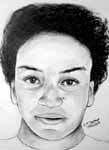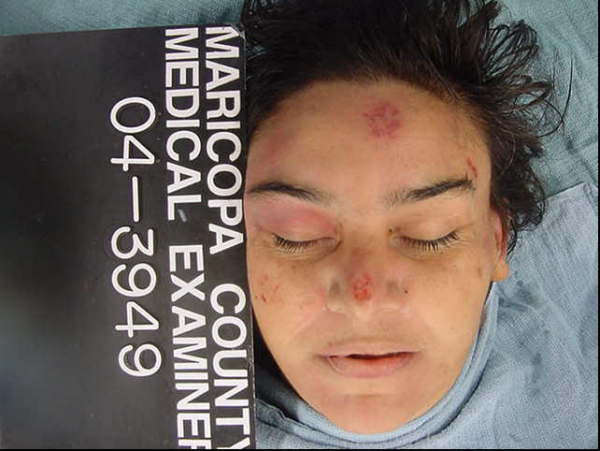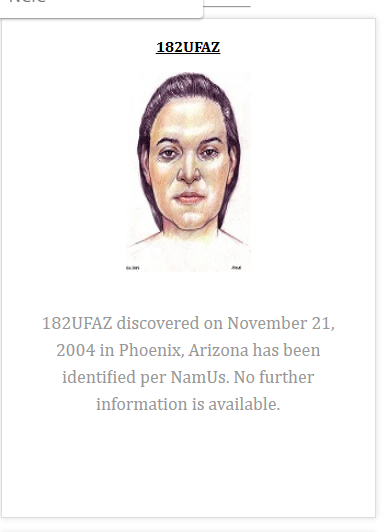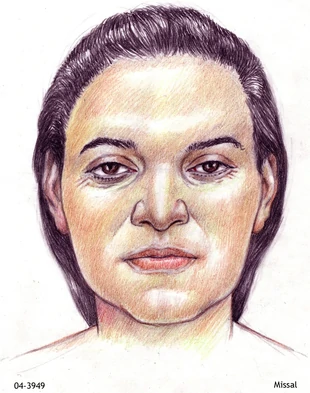
AZ PHOENIX JANE DOE: W/HF, 40-50, found victim of hit-and-run in Phoenix, AZ - 21 Nov 2004 *AMELIA MUÑOZ LOERA*

1603567208642.png

On November 21, 2004 a woman was found in the street at 15th Street and Broadway in Phoenix, Arizona minutes after being struck and killed by a car that left the scene. The deceased was wearing green sweatpants and a flowered t-shirt. The forensic pathologist who conducted the autopsy reported the woman was White/Caucasian or possibly Hispanic, 40-50 years old, 5′ 4″ tall, and 158 pounds with short black hair and brown eyes. Despite the fact that the woman’s face was recognizable, she remains unidentified.

Status: Research in progress

Status Update – 08/15/2020

The Phoenix Police Department has reached out to the public for assistance in locating the family of a woman killed in an apparent hit and run incident in 2004. DNA analysis has suggested that the woman may have family in Calvillo, Aguascalientes, Mexico. PPD has provided a flyer in Spanish (link below) in hopes that the information will be shared on social media and elsewhere in hopes of identifying her.


1603567327546.png
 
Last edited:
Phoenix Jane Doe (Broadway Street Phoenix Doe 1997) has been added to Gedmatch by the DNA Doe Project. As of February 22, 2021, she has almost 2,000 DNA matches. Her highest match is 371.3 cMs and there is an asterisk indicating "huge endogamy" (this is where there are many marrying within a closed community or family - Ashkenazi Jewish is an example). While 371.3 cM is a substantial match, the endogamy puts another twist on how that plays out. She is on the Google drive spreadsheet at:
 

Author: John Tanet
Published: 8:58 AM MST September 12, 2023
Updated: 8:58 AM MST September 12, 2023

PHOENIX — No one knew who Amelia Muñoz Loera was.

The 41-year-old, born in Mexico, was killed in a 2004 hit-and-run crash in Phoenix. At the time of her death, investigators could find no clues to her identity, and the case went cold for 16 years.

Now, a DNA test in Mexico provided the final piece to the puzzle, and gave Loera's family the answers they deserved.

In 2020, detectives with the Phoenix Police Department brought Loera to the DNA Doe Project (DDP). It's a volunteer research organization of investigative genetic genealogists dedicated to returning unidentified human remains to their families.

Although it was "relatively straightforward" to assemble a working DNA profile for Loera, the organization said in a press release, finding the people who would know her was the real challenge.

Loera's family came from the Aguascalientes region of Mexico, which DDP described as a tightly-woven community with a complicated genetic background.

Picking her family out of that web would be tough.

"This was one of the most challenging cases of endogamy imaginable - our closest matches shared two close relationship paths with our Doe,” said investigative genetic genealogist Lisa Ivany.

“One of those paths led to a New Yorker who served in the American Revolutionary War, which was quite a surprise in a case with deep Mexican roots!”

The DDP noted that recent immigrants and minority populations posed an extra investigative challenge. Far fewer of their relatives tend to upload DNA information to online databases.

After three years and 1,300 hours of investigation, the case remained unsolved, DDP said. But then, a lead.

Loera's niece tested her own DNA on FamilyTreeDNA and in a single weekend, the DDP had their match.

“Ultimately, we are so grateful that a close member of Amelia’s family made the decision to test in an effort to locate her,” Ivany added. “The more people that choose to test at FamilyTreeDNA or upload to GEDmatch means that we have a better chance of reuniting these individuals with their families."

After almost two decades, Loera's family was finally given closure. To date, DDP has helped resolve more than 100 cases of unidentified human remains.
 

Author: John Tanet
Published: 8:58 AM MST September 12, 2023
Updated: 8:58 AM MST September 12, 2023

PHOENIX — No one knew who Amelia Muñoz Loera was.

The 41-year-old, born in Mexico, was killed in a 2004 hit-and-run crash in Phoenix. At the time of her death, investigators could find no clues to her identity, and the case went cold for 16 years.

Now, a DNA test in Mexico provided the final piece to the puzzle, and gave Loera's family the answers they deserved.

In 2020, detectives with the Phoenix Police Department brought Loera to the DNA Doe Project (DDP). It's a volunteer research organization of investigative genetic genealogists dedicated to returning unidentified human remains to their families.

Although it was "relatively straightforward" to assemble a working DNA profile for Loera, the organization said in a press release, finding the people who would know her was the real challenge.

Loera's family came from the Aguascalientes region of Mexico, which DDP described as a tightly-woven community with a complicated genetic background.

Picking her family out of that web would be tough.

"This was one of the most challenging cases of endogamy imaginable - our closest matches shared two close relationship paths with our Doe,” said investigative genetic genealogist Lisa Ivany.

“One of those paths led to a New Yorker who served in the American Revolutionary War, which was quite a surprise in a case with deep Mexican roots!”

The DDP noted that recent immigrants and minority populations posed an extra investigative challenge. Far fewer of their relatives tend to upload DNA information to online databases.

After three years and 1,300 hours of investigation, the case remained unsolved, DDP said. But then, a lead.

Loera's niece tested her own DNA on FamilyTreeDNA and in a single weekend, the DDP had their match.

“Ultimately, we are so grateful that a close member of Amelia’s family made the decision to test in an effort to locate her,” Ivany added. “The more people that choose to test at FamilyTreeDNA or upload to GEDmatch means that we have a better chance of reuniting these individuals with their families."

After almost two decades, Loera's family was finally given closure. To date, DDP has helped resolve more than 100 cases of unidentified human remains.
This is what great news! They’re able to get a case solved over the border! Great job, too!
 

Forum statistics

Threads
3,283
Messages
298,567
Members
1,106
Latest member
Testerv
Back
Top Bottom