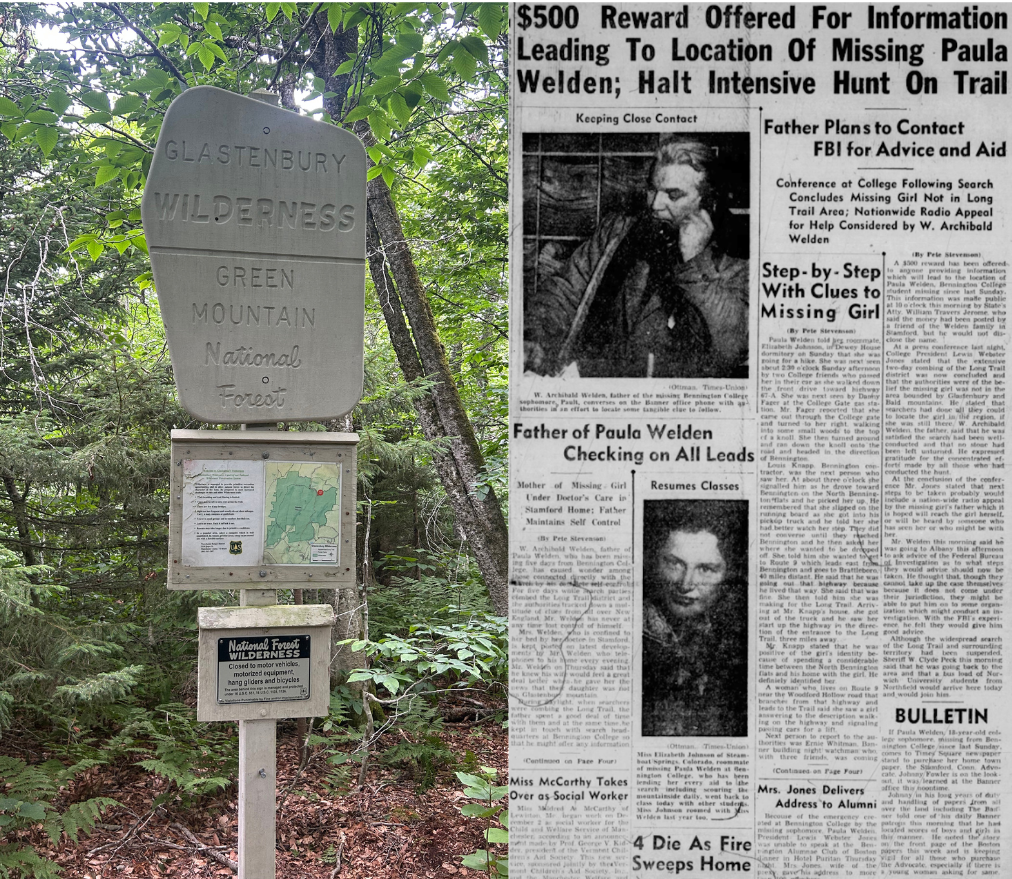
December 1, 1946, an 18-year-old college student named Paula Welden vanished while taking a hike on the Long Trail near Glastenbury Mountain. Welden had informed her roommate that she intended to go for a walk, but she never returned. The subsequent search involved hundreds of volunteers...

vermontdailychronicle.com
Paula Welden disappears 79 years ago today
December 1, 2025
Nestled within the picturesque wilderness of southwestern Vermont lies an area shrouded in mystery and eerie tales—the Bennington Triangle. This region, encompassing the towns of Bennington, Woodford, Shaftsbury, and Glastenbury, has gained notoriety due to a series of unexplained disappearances that occurred between the 1940s and 1950s. The enigmatic nature of these events has fueled speculations and given rise to numerous theories attempting to unravel the secrets hidden within the Bennington Triangle.
The Disappearances
During the period from 1945 to 1950, a string of unsolved vanishings sent shockwaves through the local communities, leaving investigators and residents alike puzzled. Let’s examine some of the most notable cases within the Bennington Triangle.
Middie Rivers – November 1945
The first mysterious disappearance involved Middie Rivers, a 74-year-old experienced hunting guide. In November 1945, Rivers was leading a group of four hunters near Glastenbury Mountain. During the excursion, Rivers became separated from the group and was never seen again. Despite extensive searches by law enforcement and volunteers, no trace of Rivers was ever found. (Source: [1])
Paula Welden – December 1946
One year later, on December 1, 1946, an 18-year-old college student named Paula Welden vanished while taking a hike on the Long Trail near Glastenbury Mountain. Welden had informed her roommate that she intended to go for a walk, but she never returned. The subsequent search involved hundreds of volunteers, including military personnel, but no concrete evidence was discovered. Welden’s disappearance remains one of the most perplexing cases in the region’s history. (Source: [2])
James E. Tedford – October 1949
In another baffling incident, James E. Tedford, a 68-year-old World War II veteran, disappeared under inexplicable circumstances. On December 1, 1949, Tedford boarded a bus in Bennington bound for St. Albans. Witnesses later testified that they had seen Tedford on the bus, but when the bus arrived at its destination, Tedford was nowhere to be found. Strangely, his belongings, including an open bus timetable and an unclaimed bus ticket, were discovered on the bus. Despite extensive searches, no trace of Tedford was ever uncovered. (Source: [3])
The circumstances of Tedford’s disappearance from the bus remain unclear. There are no reliable accounts or eyewitness testimonies describing the exact moment or manner in which he vanished. It is as if he simply disappeared during the bus ride without anyone noticing his departure. This puzzling aspect of the case has fueled speculation and various theories attempting to explain what might have happened to him. However, the lack of concrete evidence or witnesses has made it difficult to establish a definitive explanation for his disappearance from the bus.
Paul Jepson – October 1950
The fourth case within the Bennington Triangle that gained significant attention involved the disappearance of three-year-old Paul Jepson. On October 12, 1950, Paul vanished while his mother was tending to the family’s pigs at their Glastenbury farmhouse. A massive search involving the Vermont State Police and the U.S. Army was launched, but no conclusive evidence or clues were found. The disappearance of such a young child only added to the haunting mystique of the Bennington Triangle. (Source: [4])
Frieda Langer – October 1950
Frieda Langer, the final victim of the “Bennington Triangle,” disappeared on October 28, 1950, just sixteen days after Jepson. While camping near the Somerset Reservoir, Langer fell into a stream and needed a change of clothes during a hike with her cousin, Herbert Elsner. Despite assuring him of a prompt return, she never came back. Elsner’s search for Langer yielded no results, despite extensive efforts involving multiple searchers, aircraft, and helicopters. This case would prove to have a different outcome compared to the previous four disappearances in the area.
It wasn’t until May 12, 1951, over six months after Langer’s disappearance, that a skeletonized body was discovered three and a half miles away from the family’s campsite. Interestingly, this particular area had received only a cursory search during the initial investigation. The remains were positively identified as those of Frieda Langer, yet due to their deteriorated state, the cause of death remained undetermined. The North Adams Transcript reported that officials believed Langer had “fallen down [a] bank and drowned in [a] hole on the dark and rainy night of her disappearance.”
Theories and Speculations
The unexplained nature of the disappearances within the Bennington Triangle has led to a multitude of theories attempting to shed light on the mysteries. Let’s explore some of the most prominent hypotheses:
Serial Killer
One prevailing theory suggests the presence of a serial killer operating within the Bennington Triangle. Proponents argue that the similarities between the cases, such as the remote location and the victims’ disappearances, indicate a possible common culprit. However, the lack of physical evidence connecting the cases and the diverse profiles of the victims cast doubt on this theory. (Source: [5])
Supernatural Forces
Some speculate that supernatural or paranormal entities may be responsible for the disappearances. The dense forests and the region’s rich folklore about ghosts and spirits have fueled beliefs in otherworldly involvement. However, such theories lack concrete evidence and rely heavily on folklore and personal accounts.
Wilderness Hazards
The Bennington Triangle is known for its rugged terrain, unpredictable weather, and vast forests, which pose inherent risks to hikers and travelers. Proponents of this theory argue that the disappearances could be attributed to accidents, animal attacks, or natural hazards. However, this explanation does not account for the lack of evidence or the unusual circumstances surrounding some of the cases. (Source: [6])
Interdimensional Phenomena
An unconventional theory suggests the existence of interdimensional portals or vortexes within the Bennington Triangle. According to this hypothesis, individuals may unknowingly cross into alternate dimensions, leading to their disappearance. While highly speculative, this theory attempts to explain the mysterious nature of the vanishings.
The Bennington Triangle, a place of mystery and intrigue, holds an uncanny allure that transcends the boundaries of the ordinary. It is a realm where the preternatural seems to weave seamlessly into the fabric of reality. Within its boundaries, stories of inexplicable phenomena, strange disappearances, and eerie encounters abound, leaving an indelible mark on the collective imagination.
The mysteries of the Bennington Triangle remain elusive, defying easy explanations. It is a testament to the power of the preternatural, the inexplicable, and the enduring allure of the unknown. In the heart of this bewitching realm, one can’t help but question the boundaries of reality and ponder the enigma that lies just beyond our grasp.



 www.crimewatchers.net