Is anyone watching the Lindsay Clancy trial?

I am watching the Lindsay Clancy trial unfold, and this is easily one of the most difficult cases I have witnessed. Three children died and now the jury must decide if their mother was criminally responsible for their deaths.

The prosecution is arguing that her actions were premeditated and that she knew exactly what she was doing. The defense is arguing that her mental state impaired her ability to know or control her actions. There is still a lot of evidence to be presented, specifically the medical evidence, so I am trying hard not to make my mind up until it is all presented.

What I have noticed is how challenging it must be to determine actual mental illness versus a made-up legal defense. On the other hand, I do not want to focus so much on her state that we forget about the victims. They were the children who were killed.

What do you think of the evidence that has been presented so far?
 
Yeahhh....It's an interesting trial because it's not "did she do it". She absolutely did it. But was she criminally responsible?

Based on what I've heard, she was pleading for help for a very long time. Literally asked for help SO many times. She did not want to harm the children. There is a documented history of this, and I don't believe it's made up at all. In fact, she's actually suing for malpractice due to the (lack of proper) care she received. Her husband ALSO filed suit against her doctors.


Her husband, knowing she was struggling with these thoughts...still left her home alone with them. No, he's not "responsible" for their deaths, but I certainly have several concerns with pieces of his testimony.
 
Prior to the murders, Lindsay Clancy sought medical treatment beginning in September 2022 for her anxiety and increasingly poor and deteriorating mental health condition, the lawsuit shows. Over the next few months, she was prescribed sertraline (also known as Zoloft), trazodone, fluoxetine (also known as Prozac), zolpidem tartrate (also known as Ambien), mirtazapine (also known as Remeron), clonazepam (also known as Klonopin), quetiapine fumarate (also known as Seroquel), diazepam (also known as Valium), and lamotrigine (also known as Lamictal).

The medications did not help, according to the lawsuit, and Lindsay Clancy was experiencing worsening anxiety, bad insomnia and paranoia of getting suicidal thoughts. She was only sleeping three hours eventually and felt disoriented, disconnected from her body and like she was in a panic state.

Lindsay Clancy sought treatment in an emergency room in November 2022 at which point she reported feeling afraid something awful might happen. The lawsuit alleges she quickly reported the negative impacts of the medications she was prescribed, noting feeling of numbness and panic attacks.

It was the end of November and beginning of December when she first reported suicidal ideation, the lawsuit shows. On Dec. 5, 2022, she contacted ASPIRE crisis support due to having intrusive thoughts of wanting to die. She reported that she believed her ongoing symptoms were connected to the medications she was being prescribed.

A few days later on Dec. 9, Patrick Clancy called the nurse's office and said it was fairly urgent that they speak about his wife's panic and suicidal ideation. The Clancy's were advised that she continue taking the medications.

Lindsay Clancy continued to experience suicidal ideation and continued to seek help, the suit alleges. On Dec. 20, 2022, she admitted herself into a day hospital program at Women & Infants Hospital for patients with post-partum depression. She said she started having passive suicidal ideation immediately after starting quetiapine fumarate (also known as Seroquel). She also said she could not feel fear, and she reported a general inability to function, as well as a feeling of numbness and severe depression.

Women & Infants determined Lindsay Clancy's mental health issues were likely due to "overmedication and misdiagnosis" and that its day program was not appropriate for her, the lawsuit states. They reached out to her nurse, who allegedly failed to respond to them.

As her condition continued to deteriorate, Lindsay Clancy admitted herself to McLean Hospital on Jan. 1, 2023, as a result of suicidal ideation, and stayed there until Jan. 5, according to the lawsuit.

Patrick Clancy's civil suit also alleges that his wife's providers were only meeting with her for 17 minutes at a time in that month. On Jan. 16, 2022, less than 10 days before the alleged murders, Lindsay Clancy reported that caring for her baby felt forced. She had her final doctor's appointment on Jan. 23 -- also 17 minutes long.

She is accused of killing her three kids the next day.

"Dr. Tufts and Nurse Jollotta, and through them their employers Aster and South Shore Health, were aware that Lindsay was experiencing suicidal ideation and a critically deteriorating psychiatric condition while in their care and failed to take reasonable steps to properly treat her," the lawsuit concludes. "Further it is more likely than not that, had Dr. Tufts and Nurse Jollotta appreciated the severe nature of Lindsay's mental health condition, they would have altered their treatment plans to properly treat Lindsay and, more likely than not, Lindsay would not have harmed or killed Cora, Dawson, and Callan, as is alleged."

 
@TrueVerdict welcome!
:welcome:

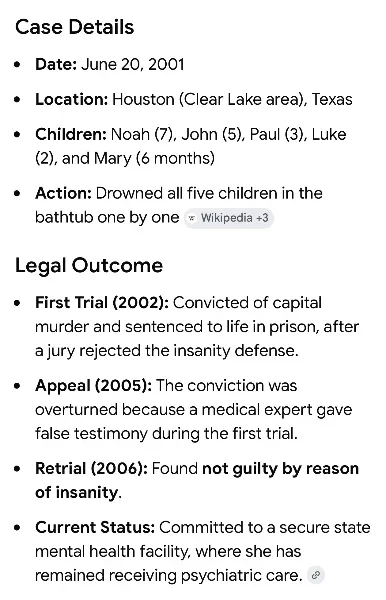
I have not had a chance to watch that case, but from what you wrote and what shewho listed, it reminds me of Andrea Yates! I did follow her trial. I think they got it right in the long run. I had a family member who suffered from severe schizophrenia, and he lit himself on fire! I had no idea he was that ill, other than once he asked me if I ever saw angels. So he was seeing things that weren’t there. I only wished I understood the severity of it before he hurt himself. He succumbed to his injuries a couple of years afterward. He was otherwise a really nice person.

Here’s a little bit more about Andrea Yates.


IMG_3900.webp
 
The legal standard for insanity is not the same thing as just saying "I'm insane" and walking away. It's rarely used, and it's really hard to prove. If the jury finds that she knew what she was doing and planned it and carried it out with awareness, then that's what prison is for. Scripture does call civil authorities to punish wrongdoing. Romans 13 says the government doesn't bear the sword in vain. That means real consequences when a life is taken unjustly. Compassion for mental illness shouldn't erase justice.
 
Based on what I've heard, she was pleading for help for a very long time. Literally asked for help SO many times. She did not want to harm the children. There is a documented history of this, and I don't believe it's made up at all. In fact, she's actually suing for malpractice due to the (lack of proper) care she received. Her husband ALSO filed suit against her doctors.
I do not deny that she asked for help or that she was struggling mentally. That evidence should be considered. But asking for help does not automatically prove that she was not criminally responsible when she killed her children. Those are two entirely different questions.

A person can be mentally ill, receive inadequate treatment, and still understand what she is doing and be capable of choosing not to do it. Filing a malpractice lawsuit does not prove otherwise. A lawsuit contains allegations that still have to be proven. Her husband filing one does not establish her criminal defense either.

If she believed there was any possibility that she might harm those children, they should never have been left alone in her care. She could have told her husband plainly, called 911, gone to an emergency room, or insisted that someone else take care of them until she was stable. The children were completely helpless and depended upon the adults around them for protection.

I can have compassion for someone suffering from mental illness while still demanding justice for three children who were strangled to death. Mental illness is relevant evidence, but it is not an automatic eraser of personal responsibility. That must be proven from her condition at the exact time of the killings, not simply assumed because she previously sought help.
 
I wonder if he can sue the hospital for negligence. We had a case here that while the mom didn't kill her kids, she ended up committing suicide, but her treatment, mal treatment and dismissal of signs were found to have been contributive.
 
Prior to the murders, Lindsay Clancy sought medical treatment beginning in September 2022 for her anxiety and increasingly poor and deteriorating mental health condition, the lawsuit shows. Over the next few months, she was prescribed sertraline (also known as Zoloft), trazodone, fluoxetine (also known as Prozac), zolpidem tartrate (also known as Ambien), mirtazapine (also known as Remeron), clonazepam (also known as Klonopin), quetiapine fumarate (also known as Seroquel), diazepam (also known as Valium), and lamotrigine (also known as Lamictal).

The medications did not help, according to the lawsuit, and Lindsay Clancy was experiencing worsening anxiety, bad insomnia and paranoia of getting suicidal thoughts. She was only sleeping three hours eventually and felt disoriented, disconnected from her body and like she was in a panic state.

Lindsay Clancy sought treatment in an emergency room in November 2022 at which point she reported feeling afraid something awful might happen. The lawsuit alleges she quickly reported the negative impacts of the medications she was prescribed, noting feeling of numbness and panic attacks.

It was the end of November and beginning of December when she first reported suicidal ideation, the lawsuit shows. On Dec. 5, 2022, she contacted ASPIRE crisis support due to having intrusive thoughts of wanting to die. She reported that she believed her ongoing symptoms were connected to the medications she was being prescribed.

A few days later on Dec. 9, Patrick Clancy called the nurse's office and said it was fairly urgent that they speak about his wife's panic and suicidal ideation. The Clancy's were advised that she continue taking the medications.

Lindsay Clancy continued to experience suicidal ideation and continued to seek help, the suit alleges. On Dec. 20, 2022, she admitted herself into a day hospital program at Women & Infants Hospital for patients with post-partum depression. She said she started having passive suicidal ideation immediately after starting quetiapine fumarate (also known as Seroquel). She also said she could not feel fear, and she reported a general inability to function, as well as a feeling of numbness and severe depression.

Women & Infants determined Lindsay Clancy's mental health issues were likely due to "overmedication and misdiagnosis" and that its day program was not appropriate for her, the lawsuit states. They reached out to her nurse, who allegedly failed to respond to them.

As her condition continued to deteriorate, Lindsay Clancy admitted herself to McLean Hospital on Jan. 1, 2023, as a result of suicidal ideation, and stayed there until Jan. 5, according to the lawsuit.

Patrick Clancy's civil suit also alleges that his wife's providers were only meeting with her for 17 minutes at a time in that month. On Jan. 16, 2022, less than 10 days before the alleged murders, Lindsay Clancy reported that caring for her baby felt forced. She had her final doctor's appointment on Jan. 23 -- also 17 minutes long.

She is accused of killing her three kids the next day.

"Dr. Tufts and Nurse Jollotta, and through them their employers Aster and South Shore Health, were aware that Lindsay was experiencing suicidal ideation and a critically deteriorating psychiatric condition while in their care and failed to take reasonable steps to properly treat her," the lawsuit concludes. "Further it is more likely than not that, had Dr. Tufts and Nurse Jollotta appreciated the severe nature of Lindsay's mental health condition, they would have altered their treatment plans to properly treat Lindsay and, more likely than not, Lindsay would not have harmed or killed Cora, Dawson, and Callan, as is alleged."
I understand the point being made, and I do believe Lindsay Clancy was struggling mentally and may have received poor care. But that still does not automatically mean she was not criminally responsible for killing her children.

The wrongful-death lawsuit is making allegations against her doctors. Those allegations may turn out to have merit, but they do not prove that she was legally insane when she killed Cora, Dawson, and Callan. Her doctors could have failed her, and she could still have known exactly what she was doing. Both things can be true.

The long list of medications also sounds alarming when it is read all at once, but Patrick testified that many of them were changed or stopped quickly and that she was not taking all of those drugs together. Simply listing every prescription she received over several months does not prove she was incapable of understanding her actions that night.

What stands out to me is her behavior on the day of the killings. Patrick said it had been one of her better days. She took one of the children to an appointment, exchanged normal messages and pictures, built a snowman, and did activities with the children. She did not tell Patrick she was hearing voices or that she was afraid she might hurt anyone. She did not tell him not to leave her alone with the children.

In fact, she was the one who suggested that he leave to pick up food and medication. The prosecution says she checked the distances and timing. While he was gone, two different people spoke with her on the phone and said she sounded normal. That does not prove everything by itself, but it does support the prosecution’s argument that she deliberately created an opportunity to be alone with the children.

This was not one quick, impulsive act either. All three children were strangled separately with exercise bands. They were found in different areas of the basement. That meant three separate acts, with time to stop between each one.

Then, when Patrick returned, the bedroom door was locked. She told him she had tried to kill herself, but when he asked where the children were, she only said they were in the basement. She did not immediately tell him they had been strangled or urge him to hurry and try to save them. To me, that sounds like someone who understood that what she had done was wrong and was hiding it.

Her journals do show that she was depressed, anxious, exhausted, and overwhelmed. But they also show resentment toward the older children and a desire to escape the burden of caring for everyone. That can be seen as motive just as much as mental illness. Feeling overwhelmed or resentful does not mean a person no longer knows right from wrong.

The claim that a male voice ordered her to kill the children was reported later in the hospital. The jury will have to decide whether that claim is believable. Even if she did hear a voice, the question still remains whether she understood what she was doing and whether she could have refused to do it.

A psychiatrist who examined her two days later said she was not showing signs of psychosis during the interview. She spoke clearly, asked whether she had a lawyer, asked about her family, and said she was horrified. That does not settle the entire case, but it is still important evidence.

I am not saying she was perfectly healthy or that her doctors did everything right. Clearly she was in serious trouble. But mental illness is not the same thing as being legally unable to understand or control your actions.

She had also reported disturbing thoughts before. If she truly believed the children were in danger from her, she could have insisted that she never be left alone with them. She could have called 911, returned to the hospital, or plainly told Patrick to take the children somewhere safe. Instead, she sent him away.

That is why I believe the prosecution has a strong case. She appeared to function normally, created time alone with the children, killed them one by one, concealed what she had done, and later showed awareness of the consequences. Poor medical care may explain some of what led up to that night, but it does not automatically excuse the murder of three helpless children.
 
I have not had a chance to watch that case, but from what you wrote and what shewho listed, it reminds me of Andrea Yates! I did follow her trial. I think they got it right in the long run. I had a family member who suffered from severe schizophrenia, and he lit himself on fire! I had no idea he was that ill, other than once he asked me if I ever saw angels. So he was seeing things that weren’t there. I only wished I understood the severity of it before he hurt himself. He succumbed to his injuries a couple of years afterward. He was otherwise a really nice person.
Thanks for the welcome. :wave:

That is heartbreaking, and I am sorry your family went through that. Severe mental illness can be far worse than people realize, especially when someone hides what they are experiencing or does not fully understand it themselves. Your relative seeing angels may have been one of the few outward signs anyone noticed.

I can understand why this case reminds you of Andrea Yates. The difference for me is that each case has to stand on its own evidence. I am not denying that Lindsay Clancy was mentally ill or that her doctors may have failed her. I just have not seen enough evidence yet that she was so psychotic that she did not understand what she was doing or could not stop herself.

The planning, sending her husband away, killing each child separately, and then not immediately telling him what she had done are hard for me to overlook. Those details seem very different from someone acting in a completely disconnected state without any awareness of right and wrong.

I do have compassion for genuine mental illness, especially after hearing what happened to your family member. At the same time, compassion for the person who was ill cannot make us forget the three children who had no way to protect themselves. The jury has to carefully consider all of it and decide whether this was true legal insanity or whether mental illness is being used to excuse deliberate actions.

 
Last edited:
As I watch this on Court TV, I’m continually struck by how much time is spent pushing for the defense. Guest after guest comes on explaining postpartum psychosis, mental illness in general, medication side-effects, and every reason Lindsay Clancy should be found not criminally responsible. What I do not hear nearly as often is someone explaining the prosecution’s case with equal vigor. There were 3 children brutally murdered, and not one seems to be feeling sorry for them?

The prosecution is NOT saying she was healthy. They are saying that she knew what she was doing was wrong. She sent her husband out of the house, created situations where she would have time alone with each child, then took them into the basement and strangled each of them separately with exercise bands. This was not one sudden movement made in a split second. It was three separate acts against three helpless children, one after another, with an opportunity to stop before moving on to the next child. And then did not immediately confess to her husband when he came home. Her own journals showed she was resentful and wanted out from under the burden of having to care for everyone else. These facts deserve more consideration than they have received so far.

Just because she was mentally ill does not mean she didn’t know what she was doing. Millions of people have depression, anxiety, insomnia, and scary thoughts in their heads without resorting to killing their children. The question is whether she was so delusional that she did not know what she was doing OR could not stop herself. I have not seen that yet.

And then there’s the medication issue. If you are prescribed medication and you don’t take it as directed, is that an automatic Get Out of Jail Free card? We don’t allow people to excuse violent crimes because they were voluntarily intoxicated. So why should someone get a free pass on personal responsibility here unless there is clear evidence that she could not control her actions?

I’m not suggesting the doctors did a perfect job by any means. They may have dropped the ball on her treatment so severely that the civil lawsuit will show negligence. But inadequate medical care does not negate criminal responsibility. They can and do happen at the same time.

Am I the only person who feels like Court TV is devoting way more time to explaining why she deserves sympathy than why she might know what she did was wrong?


.
 
Because of family events, I haven’t had the opportunity to follow this case whatsoever. Your posts are enlightening me. How much time did she take in between each child? That does seem pretty deliberate. Has she explained what she was thinking at the time? And I understand your concerns about being soft on crime, it’s way too common these days to see where sympathy is more for the perpetrator than it is for the victim.
 
Because of family events, I haven’t had the opportunity to follow this case whatsoever. Your posts are enlightening me. How much time did she take in between each child? That does seem pretty deliberate. Has she explained what she was thinking at the time? And I understand your concerns about being soft on crime, it’s way too common these days to see where sympathy is more for the perpetrator than it is for the victim.
Of all the evidence that I have seen presented so far, I have not seen anything that shows a play-by-play timeline of how long she waited before killing each child. What we do know is that she sat there and strangled them one by one, individually, once she sent her husband out of the house.

To me, that is probably one of the biggest points for the prosecution. This was not a rash act that occurred within seconds. She had to commit three separate crimes and had time to think about what she was doing with each child that she strangled. She had the opportunity to not continue but she didn't. I think, based on what I have seen so far, she knew what she was doing and should be held criminally accountable. That is simply my opinion, but I think that is the more persuasive argument.

Obviously, there is still a lot of the case to come. The expert testimony about her mental state at the time of the killings will be huge. It could solidify the prosecution's argument even more or maybe create enough doubt for a jury to side with the defense. But for now, I think she knew what she was doing.
 
I've only heard the testimony from the husband, in other words, I haven't followed the trial, but it appears to me that the woman was delusional, which to me means that in her mind, she did what she thought was right.
 
I've only heard the testimony from the husband, in other words, I haven't followed the trial, but it appears to me that the woman was delusional, which to me means that in her mind, she did what she thought was right.
Lindsay Clancy was so broken up about killing her kids that she was looking forward to moving to Spalding so she could keep recovering. Funny how the suicidal thoughts just vanished after she killed them. Almost like they were never really there.

A mother who killed her three children against her will, while in a real psychosis, would be completely crushed by what she had done. Lindsay was thinking about herself the whole time. It was her medical plan, her recovery, calling Patrick to talk about her injuries and not asking about him or the kids.

A woman who actually wants to die does not look forward to getting better. And a woman who never wanted to kill her children would be disgusted, broken, and overwhelmed once she realized what she had done.

If she really thought she was doing the right thing in a delusion, once that lifted she should have been devastated about the kids, not focused on her own recovery plan?
 

Forum statistics

Threads
3,294
Messages
300,188
Members
1,114
Latest member
bree
Back
Top Bottom